


Vibrant Rajasthan - Tour to the Land of History, Legends, Hotels....
- Pushkar Fair Tour Package
- Classical North India Tour Package with Nepal
- Palace on Wheels
- Colorful Heritage Rajasthan Tour Package
- Forts and Palaces of Rajasthan Tour Package
- Jewels of Rajasthan Tour Package
- Rajasthan Cultural Tour Package
- Splendours Of Rajasthan
- Pushkar Fair Tour with Golden Triangle
Junagarh Fort Bikaner
Junagarh Fort Is One Of The Unconquered Forts of Rajasthan. A Beautiful Amalgamation Of Several Architectural Styles, Junagarh Fort Is A Must See For Its 37 Palaces And Temples.
The Junagarh Fort is a legacy of Raja Rai Singhji, who was the sixth ruler of Bikaner, from 1571 AD to 1612 AD. He was a contemporary of Emperor Akbar and held a very high rank in the court.
One of the few Forts in Rajasthan not built on the top of a hill, it is an imposing structure nevertheless and has been an unconquered Fort. Only once, Kamaran captured the Fort, for a mere 24 hours! As a trusted military commander of Akbar, Raja Rai Singhji was granted fields of Gujarat and Burhanpur. He was well travelled and imbibed the art and architecture forms of the various lands that he went to. The influence of all these is clearly visible in the Junagarh Fort, made of red sandstone.
There are a number of buildings within the complex that are well worth a visit. 37 palaces, pavilions as well temples, built by several subsequent rulers, are now a tourist's delight. The fort is surrounded by a moat and has high walls. The important buildings inside the Fort are the Suraj Pol, Karan Mahal that was built to celebrate the victory over Aurangzeb, Durga Niwas, Lal Niwas, Anup Mahal from where the rulers governed the state, Chandra Mahal or Moon Palace that is decorated with carved marble panels, paintings and mirrors, Phul Mahal or Flower Palace and the Fort Museum. The museum is known for its collection of stunning jewellery, illuminated manuscripts, jars, exquisite carpets, arms and weapons, treaties, military decorations and the 'Farmans'.
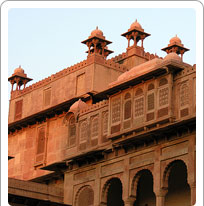
- Junagarh Fort Is One Of The Unconquered Forts Of Rajasthan...
Bikaner Hotels
Bikaner's Special
- Forts and Monuments
- Junagarh
- Lalgarh Palace
- Jain Haveli Bhandeswari
- Museums
- Ganga Singh Museum
- Sadul Museum
- Prachina Museum
- Rajasthan State Archives
- Temples
- Shiv Bari Temple
- Devi Kund
- Deshnok Temple
- Wildlife
- Gajner Wildlife Sanctuary
- Near Bikaner
- Camel Research Farm
- Gajner palace
- Kolyatji
- Katariasar Village
Hot Selling Tours
- Kerala - God's Own Country
- Rajasthan Heritage Tour
- Sikkim Delight Tour
- Jewels Of Rajasthan Tour
- The Treasures of India & Nepal
- Temple and Spices Tour
- Best Of Two Cultures (Karnataka & Kerala)
- Backwater Beach Tours Kerala
- Golden Triangle Tour with Ajanta and Ellora
- Enchanting Kerala Tour
- Colourful Heritage Tour of Rajasthan
- Classical North India with Nepal
- Classical North India Tour
- Exotic Kerala Tour
- Rajasthan Forts And Palaces Tour
- Exotic South India Tour with Backwaters of Kerala
- Golden Triangle with Ranthambore Tour
- Golden Triangle Tour 5-6